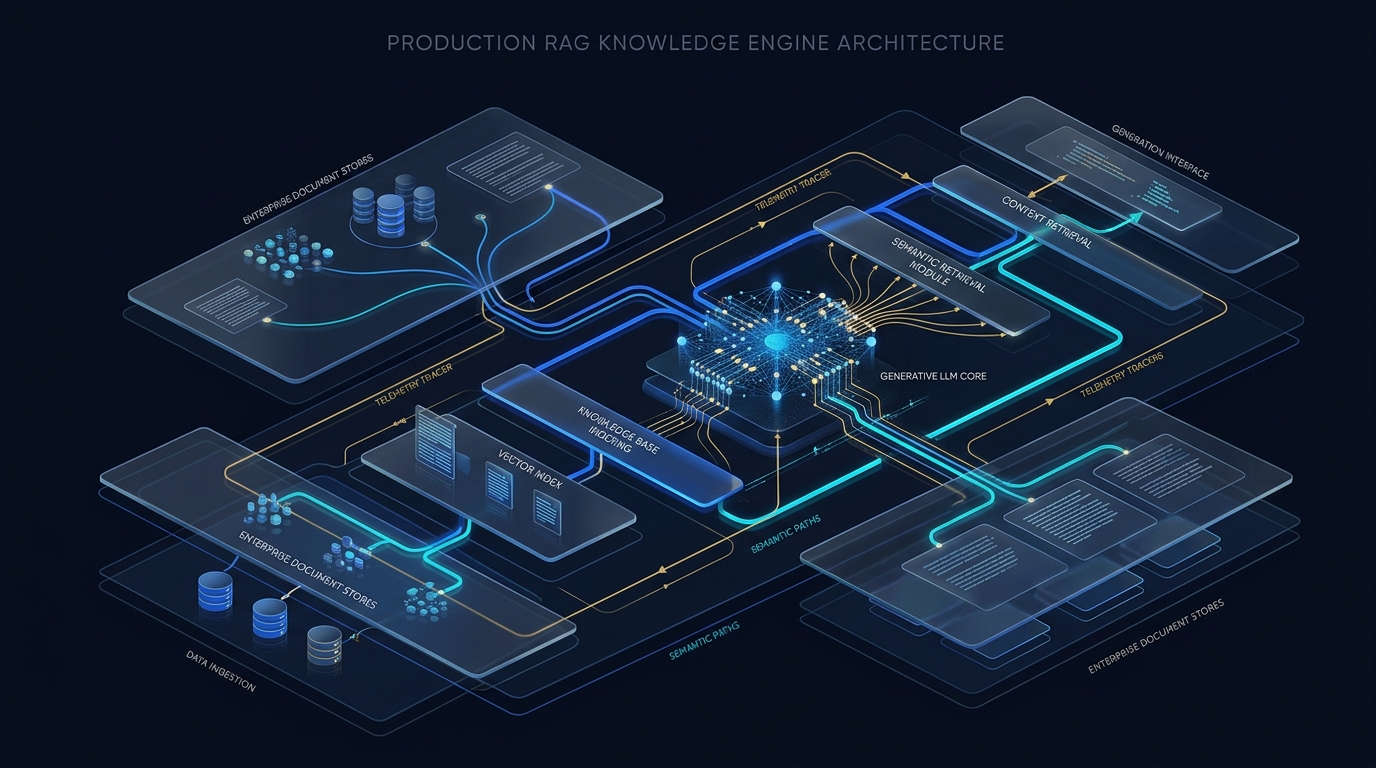
Building a Retrieval-Augmented Generation (RAG) prototype in 2026 takes about forty lines of Python. You split a handful of markdown files into 500-token chunks, compute vector embeddings using an off-the-shelf model, index them in a vector database, and prompt an LLM to answer user questions based on the top three nearest neighbors.
In a controlled sandbox with fifty curated documents, the demo looks like magic. It dazzles stakeholders, secures pilot funding, and convinces executive leadership that an autonomous corporate brain is just weeks away from rollout.
Then comes Monday morning in production.
Thousands of knowledge workers begin querying the system across millions of enterprise files: dense PDFs with multi-page financial tables, superseded internal security memos, complex technical schematics, and confidential human resource records.
Almost overnight, the illusion collapses:
- The assistant confidently recites a cloud security policy that was deprecated two quarters ago.
- An intern asks a broad query about compensation guidelines, and the vector retriever inadvertently surfaces an unredacted executive salary spreadsheet.
- A financial analyst queries an quarterly EBITDA comparison, and the system synthesizes numbers from two completely unrelated fiscal years because cosine similarity matched generic corporate phrasing rather than row-and-column context.
- System latency spikes above 4.5 seconds per request, token consumption burns through monthly infrastructure budgets in days, and user adoption plunges below ten percent.
According to enterprise AI deployment benchmarks, over 80% of enterprise RAG initiatives stall in pilot or fail within ninety days of entering production.
The failure is rarely the fault of the underlying frontier Large Language Model. The failure stems from treating enterprise knowledge retrieval as a simple vector math problem. Production RAG is not a prompt-engineering trick—it is a sophisticated distributed systems and information retrieval engineering discipline.

1. The Anatomy of Naive RAG and Why It Collapses at Scale
To solve production failures, engineering teams must first unpack why the textbook "Naive RAG" architecture inevitably degrades as document volume and user concurrency increase.
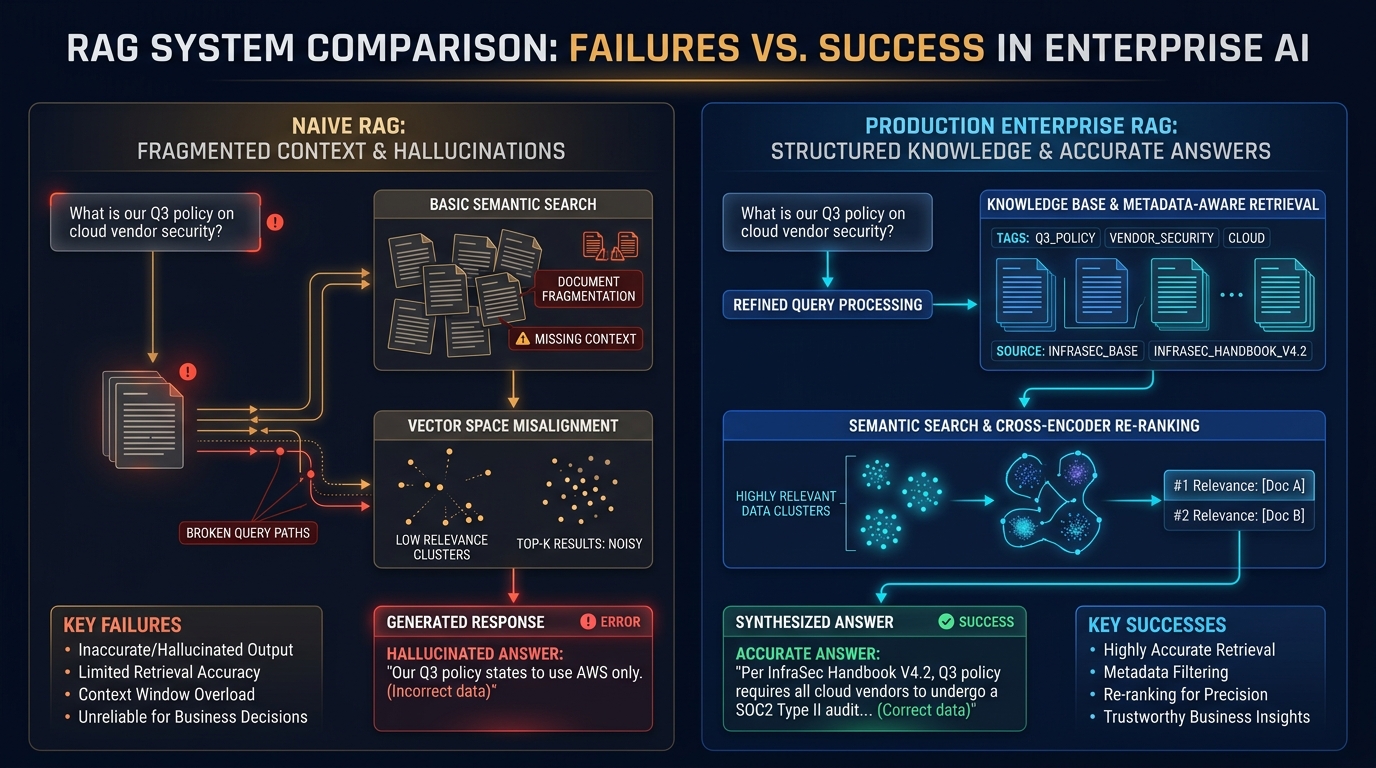
Naive RAG relies on a simplistic, linear pipeline:
- Load raw documents.
- Cut text into fixed-length character or token windows (e.g., 500 tokens with 50-token overlap).
- Generate dense vector embeddings via a bi-encoder.
- Execute approximate nearest neighbor (ANN) vector search via cosine distance.
- Stuff the top-$k$ retrieved chunks into the LLM system prompt.
In enterprise environments, this pipeline breaks down across four structural fault lines:
Failure Mode 1: Arbitrary Fixed-Window Chunking Destroys Context
Human thought and technical documentation do not organize themselves into rigid 500-token blocks. When an automated parser chops an enterprise document at token boundaries:
- A crucial conditional clause ("This SLA applies only to Tier-1 Enterprise customers with dedicated VPC deployment") gets divorced from the table of guarantees on the preceding page.
- Relational tabular data turns into gibberish. An invoice or financial ledger parsed by character count yields disconnected strings of floating numbers stripped of header metadata.
- Pronoun resolution fails completely. A chunk stating "The protocol was terminated immediately due to severe telemetry dropouts" provides zero indication of which server cluster or medical device "the protocol" actually refers to.
Failure Mode 2: Vector Similarity Blind Spots
Dense vector embeddings map semantic intent to continuous geometric vector spaces. They are brilliant at recognizing that "auto insurance quote" is conceptually similar to "vehicle coverage estimate."
However, vector embeddings are notoriously weak at lexical precision:
- Unique Identifiers: Embedding models struggle to distinguish between part number
X-904-REV-AandX-904-REV-B. - Domain Acronyms: Highly specialized acronyms (
HIPAA,EBITDA,SOC2,AML-KYC) often get blurred into generalized compliance embeddings. - Negation and Temporal Anchors: A sentence stating "Do NOT execute this script in production environments prior to v4.2 migration" has virtually identical cosine similarity to "Execute this script in production environments for v4.2 migration."
Failure Mode 3: Context Pollution and "Lost in the Middle"
As retrieval pipelines attempt to improve answer completeness, developers routinely increase top-$k$ from 3 chunks to 15 or 25 chunks.
Research from Stanford University on LLM attention dynamics revealed the "Lost in the Middle" phenomenon: language models pay high attention to tokens at the very beginning and very end of their input context, but their retrieval accuracy plummets when critical evidentiary facts are buried in the middle of a massive context payload. Flooding context with marginal chunks does not make the answer smarter; it drowns the LLM in noise and triggers catastrophic hallucination.
Failure Mode 4: Temporal Decay and Knowledge Cannibalization
Enterprises update policies, codebases, and compliance rules continuously. In a naive vector store, an archived 2021 travel reimbursement policy resides in the same vector space as the updated 2026 handbook. Because the 2021 document may contain richer, more descriptive phrasing, cosine similarity frequently ranks the obsolete policy higher than the terse 2026 update. Without strict temporal metadata scoring and document versioning, the system actively misinforms employees.
2. Pillar 1: Hybrid Search (Dense Vectors + BM25) and Cross-Encoder Re-Ranking
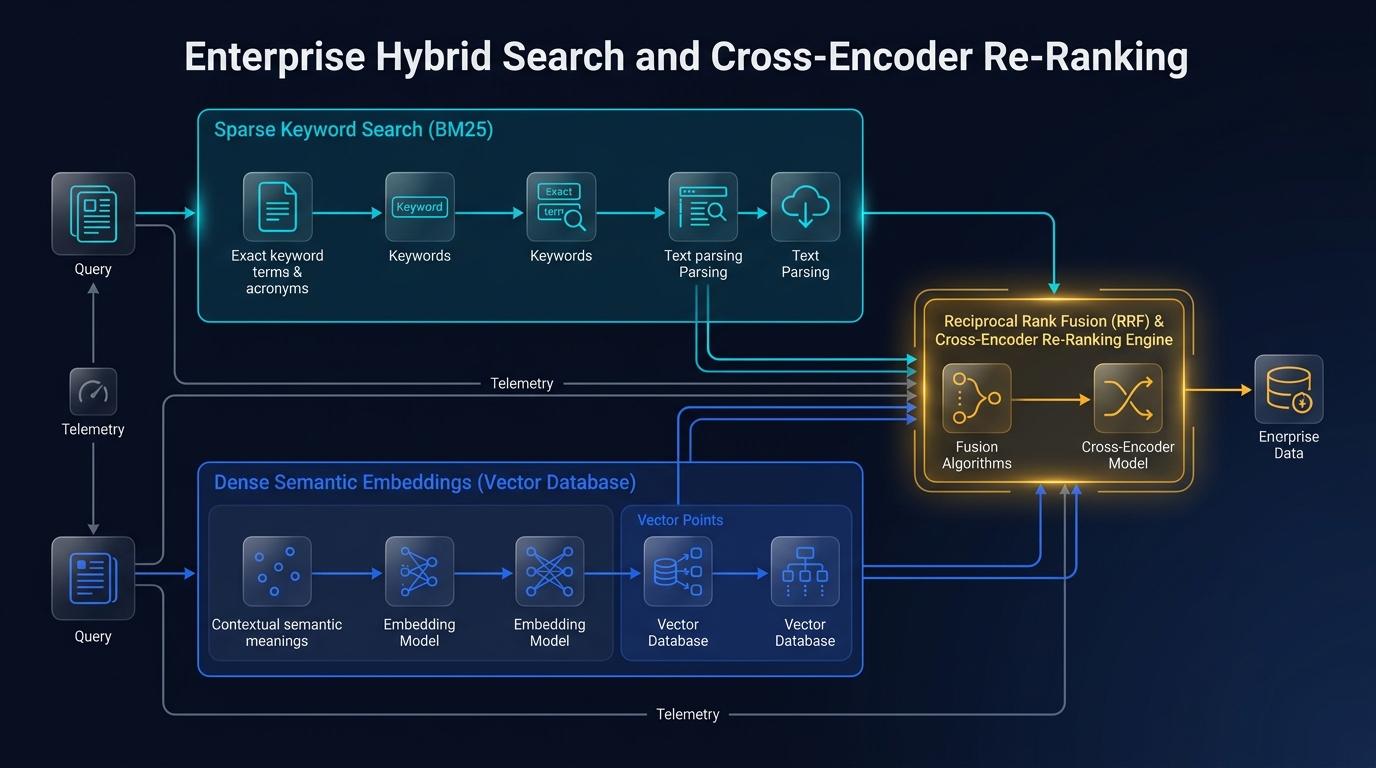
The foundational shift from prototype to production begins with abandoning pure vector search in favor of a two-stage retrieval pipeline: Hybrid Search paired with Cross-Encoder Re-Ranking.
Why Dense Embeddings Alone Are Insufficient
Production retrieval requires balancing two distinct search paradigms:
- Dense Semantic Search (Vector Embeddings): Captures conceptual nuance, synonyms, intent, and multi-lingual paraphrasing.
- Sparse Lexical Search (BM25 / SPLADE): Captures exact keyword matches, SKU strings, technical jargon, proper nouns, and specific error codes.
In an enterprise RAG system, every user query should execute against both search engines simultaneously. The sparse and dense result sets are then unified using Reciprocal Rank Fusion (RRF).
Reciprocal Rank Fusion (RRF)
RRF evaluates the relative ranks of documents across both search engines rather than trying to normalize and compare raw, non-commensurable similarity scores:
$$RRF_Score(d \in D) = \sum_{m \in M} \frac{1}{k + r_m(d)}$$
Where $M$ represents the retrieval systems (Dense Vector and BM25), $r_m(d)$ is the rank of document $d$ within system $m$, and $k$ is a constant smoothing factor (typically set to 60).
def reciprocal_rank_fusion(dense_results: list, bm25_results: list, k: int = 60) -> list:
    """
    Fuses dense vector results and sparse lexical BM25 results
    using Reciprocal Rank Fusion (RRF).
    """
    scores = {}

    # Process BM25 Sparse Rankings
    for rank, doc_id in enumerate(bm25_results):
        if doc_id not in scores:
            scores[doc_id] = 0.0
        scores[doc_id] += 1.0 / (k + rank + 1)

    # Process Dense Vector Rankings
    for rank, doc_id in enumerate(dense_results):
        if doc_id not in scores:
            scores[doc_id] = 0.0
        scores[doc_id] += 1.0 / (k + rank + 1)

    # Sort documents by fused RRF score descending
    sorted_docs = sorted(scores.items(), key=lambda item: item[1], reverse=True)
    return [doc_id for doc_id, score in sorted_docs]
The Power of Cross-Encoder Re-Ranking
Once Hybrid Search produces candidate pool of documents (e.g., top 50 candidates), you should never pass them directly to the LLM. Instead, pass those 50 candidates through a specialized Cross-Encoder Re-Ranker (such as Cohere Rerank 3 or BGE-Reranker-Large).
Understanding the mechanical difference between retrieval encoders is vital:
- Bi-Encoders (Embedding Models): Encode the user query and the document chunks independently into isolated vector vectors. The model never sees the query and document together; similarity is calculated via high-speed dot-product or cosine calculation. This enables sub-50ms search across millions of vectors, but misses subtle semantic relationships.
- Cross-Encoders (Re-Rankers): Take the query and the candidate document chunk together as a single joint input through all multi-head attention layers of the transformer. The cross-encoder evaluates the exact interplay between every word in the user's question and every word in the candidate text.
Cross-encoders are computationally heavier, which is why you cannot run them across your entire million-document corpus. But running a cross-encoder across the top 50 hybrid candidates takes under 80 milliseconds and slashes retrieval noise by up to 65%.
The top 3–5 chunks emerging from the cross-encoder contain virtually zero irrelevant clutter, allowing you to feed an exceptionally concise, high-density context into your generation LLM.
3. Pillar 2: Contextual Chunking & Metadata Enrichment
Chunking is not a text-formatting utility; it is the semantic boundary condition of your entire AI architecture. If an input chunk lacks structural and narrative context, no vector database or LLM can reconstruct the truth.
Anthropic’s Contextual Retrieval Paradigm
In late 2024, Anthropic formalized an approach that has quickly become an enterprise industry standard: Contextual Chunking.
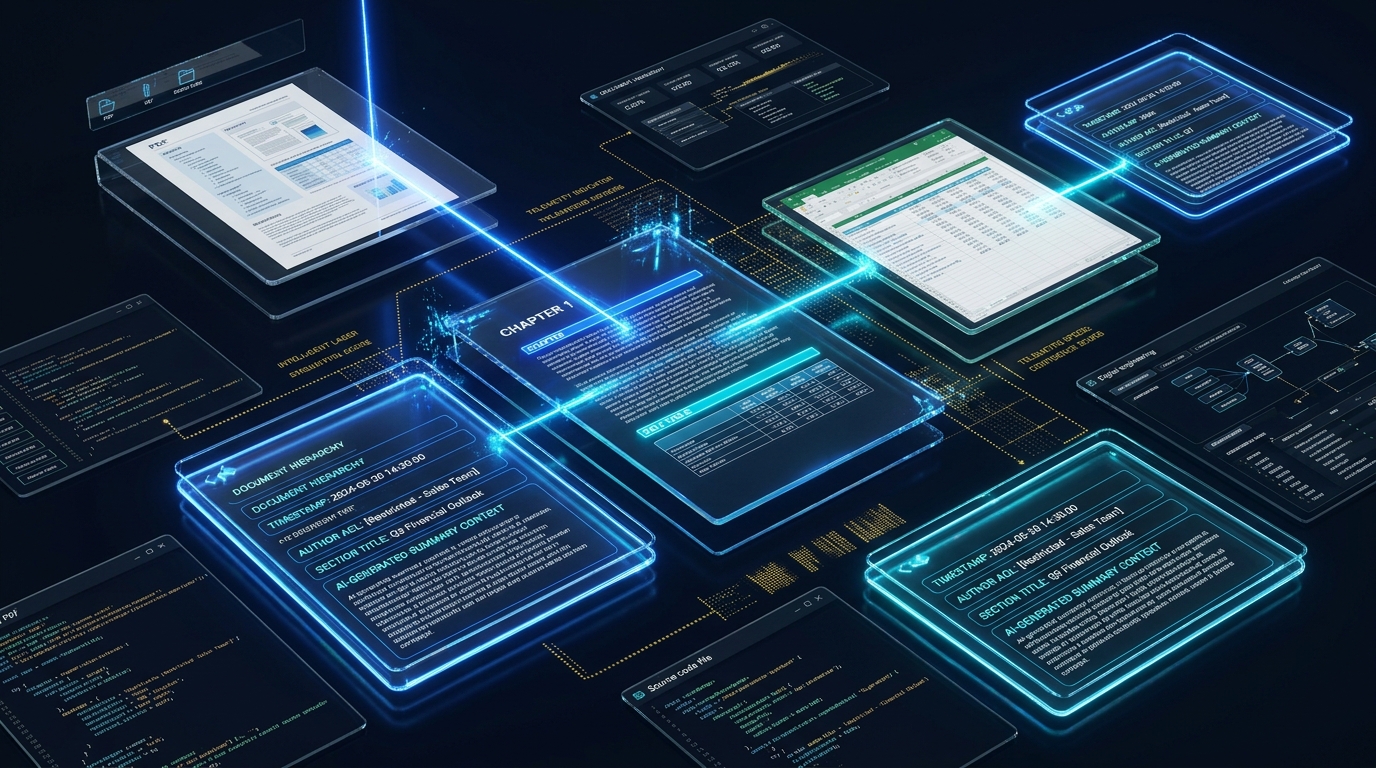
Before embedding a chunk into the vector database, an automated background LLM worker inspects the chunk in relation to the entire source document. It then synthesizes an explicit 50–100 token contextual header that is prepended directly to the chunk text before embedding:
Raw Chunk (Fails retrieval):
"Revenue declined by 4.2% year-over-year, primarily due to delayed regulatory approvals in the APAC regional expansion."Contextualized Chunk (Succeeds retrieval):
"[Context: Document: ACME Corp 2025 Annual 10-K Report | Section: Medical Devices Division | Region: APAC | Date: November 2025] Revenue declined by 4.2% year-over-year, primarily due to delayed regulatory approvals in the APAC regional expansion."
By prepending the parent document's title, scope, product line, and timestamp, the embedding vector captures the precise domain reality of the text. When a user asks "Why did APAC medical device sales drop in 2025?", the contextualized chunk matches immediately with near-perfect cosine confidence.
Small-to-Big / Parent-Document Retrieval
Another production-grade pattern is decoupling the retrieval chunk from the synthesis chunk:
- Child Chunk (Search Layer): Split documents into granular 150-token micro-chunks. These small chunks produce highly targeted embeddings that match specific queries with high semantic fidelity.
- Parent Chunk (Generation Layer): When a child chunk is selected by the retrieval engine, the system does not feed just those 150 tokens to the LLM. Instead, it looks up the child's
parent_idin a key-value store and retrieves the surrounding 1,200-token section or entire subsection.
This ensures the LLM receives the full surrounding narrative context, while the vector engine searches against razor-sharp semantic targets.
4. Enterprise Security: Multi-Tenancy & Role-Based Access Control (RBAC)
In an enterprise setting, security is not an afterthought; it is an absolute go/no-go requirement. The moment an enterprise AI system surfaces a document to a user who lacked permission to view it in the source system (SharePoint, Google Drive, Jira, or Salesforce), your application has committed a severe compliance breach.
The Catastrophic Flaw of Post-Retrieval Filtering
Naive implementations frequently attempt Post-Retrieval Filtering:
- The vector database retrieves the top 10 most relevant chunks for the user's query.
- The application checks the current user's permissions against each chunk.
- The application discards chunks the user is not authorized to see.
- The remaining chunks are sent to the LLM.
Why this breaks catastrophically:
- Recall Destruction: If the user lacks permission for the top 8 chunks, the application is left with only 2 chunks—or zero chunks—returning an empty response or a hallucination, even though valid documents existed further down the corpus.
- Side-Channel Information Leakage: Even if the text is suppressed, response timings and error codes can inadvertently reveal the existence of classified files to unauthorized personnel.
Pre-Retrieval Metadata ACL Enforcement
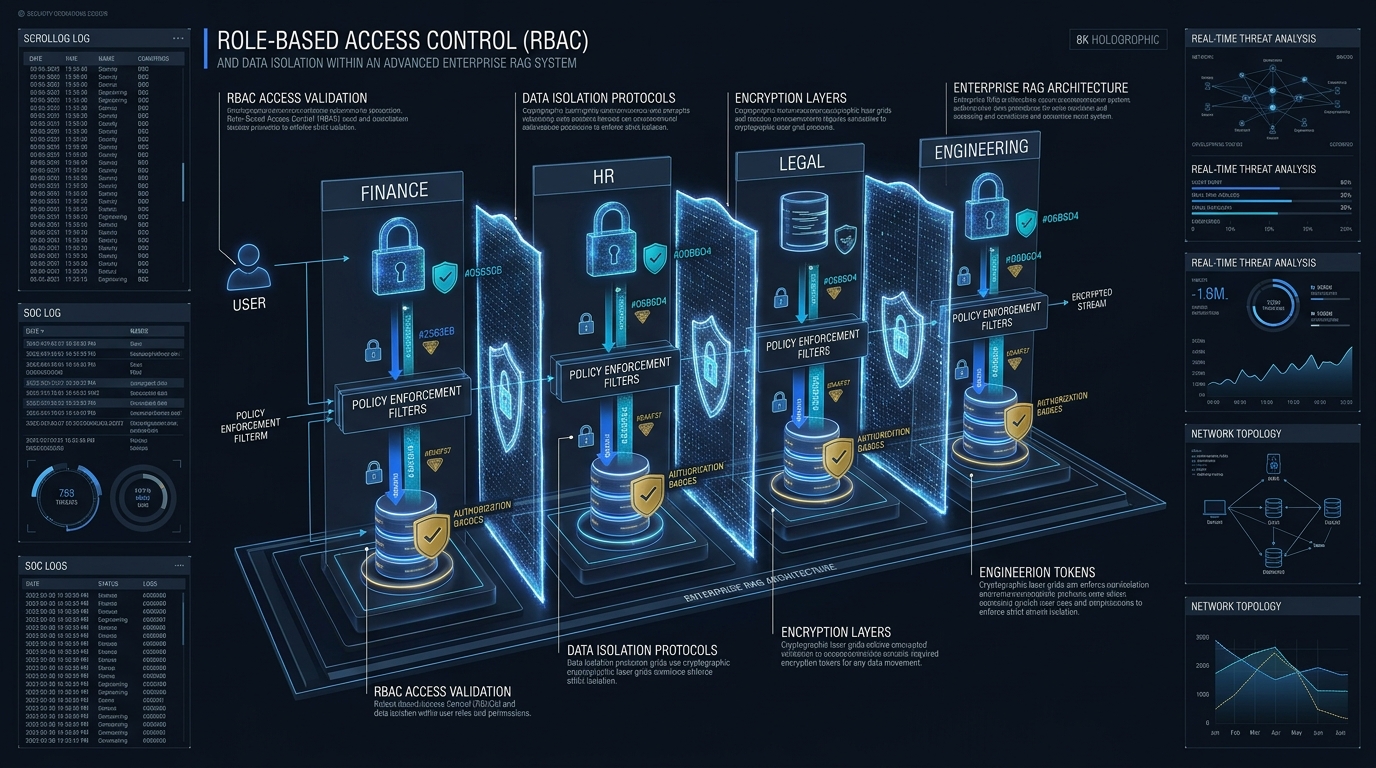
Production RAG requires Pre-Filtering at the vector engine layer.
Every document ingestion worker must synchronize security access control lists (ACLs) directly from enterprise identity providers (Microsoft Entra ID, Okta, Active Directory). When a chunk is stored, its metadata payload must include:
tenant_id: Multi-tenant enterprise boundaryallowed_groups: Active Directory security group SIDs (e.g.,["eng-staff", "security-council"])classification_level: Confidential, Internal, Publicretention_expiry: Timestamp after which the chunk must be purged
# Production Vector Query with Hard Pre-Retrieval Security Filtering
query_vector = embedding_client.embed_query(user_prompt)

retrieval_results = vector_db.query(
    vector=query_vector,
    top_k=50,
    filter={
        "and": [
            {"tenant_id": {"$eq": current_user.tenant_id}},
            {"allowed_groups": {"$in": current_user.security_groups}},
            {"classification": {"$lte": current_user.clearance_level}},
            {"is_superseded": {"$eq": False}}
        ]
    }
)
By enforcing filtering directly inside the approximate nearest neighbor search index (supported natively by production vector databases like Qdrant, Milvus, and pgvector HNSW), unauthorized chunks are strictly excluded before distance scoring occurs. Top-$k$ recall remains pristine, and cross-departmental data leakage is mathematically impossible.
5. Agentic & Self-Reflective RAG (CRAG & Self-RAG)
Standard RAG assumes a deterministic pipeline: user asks question $\rightarrow$ retrieve documents $\rightarrow$ generate response.
In production, user queries are messy, ambiguous, or reference concepts that do not exist in the database. Production systems implement Agentic and Self-Reflective loops that critique and adapt their own retrieval steps before answering.
Corrective RAG (CRAG)
Corrective RAG inserts a lightweight evaluator model between retrieval and generation:
- Retrieval Assessment: The evaluator scores the confidence of the retrieved documents against the query.
- Action Branching:
- Correct (High Confidence): If documents directly answer the prompt, synthesize immediately.
- Ambiguous (Moderate Confidence): Strip irrelevant sentences, re-write the query, and trigger a second targeted vector lookup.
- Incorrect (Zero Confidence): If no retrieved chunk addresses the question, do not pass empty context to the LLM. Instead, gracefully trigger a fallback path: route to a relational SQL database, execute a web search, or state honestly: "I searched internal compliance documentation, but no policy addressing overseas remote work stipends could be verified."
Query Rewriting and Step-Back Prompting
Users rarely write optimal search queries. An employee typing "VPN broken again on Mac after upgrade" will struggle to match an official IT knowledge base article titled "Resolution for IPSec Tunnel Negotiation Failures on macOS Sequoia."
Production pipelines implement Query Transformation micro-agents:
- Hypothetical Document Embeddings (HyDE): The LLM generates a hypothetical ideal answer first. The system embeds that hypothetical answer and uses its vector to search the database. Because answers look like answers, retrieval accuracy increases dramatically.
- Query Decomposition: Complex multi-part queries ("Compare our Q3 European marketing spend with our approved 2026 budget plan") are split into distinct sub-queries, retrieved separately, and consolidated before synthesis.
6. Observability, Latency Economics & Automated Evaluation
You cannot improve what you do not measure. Teams that evaluate RAG systems through casual human spot-checking invariably ship systems that fail in edge cases.
The RAG Triad of Metrics
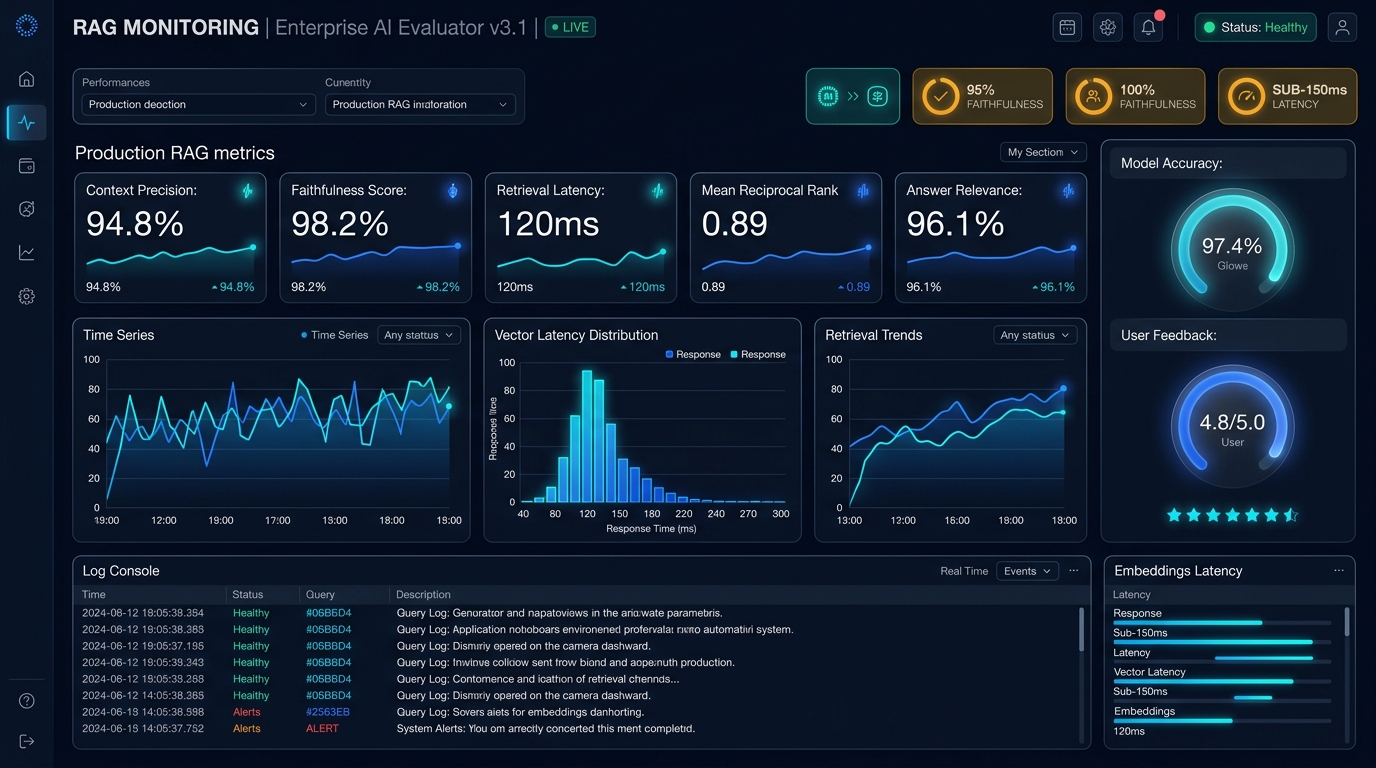
Production systems rely on automated evaluation frameworks (such as Ragas or TruLens) that run continuous telemetry on every production query using a synthetic evaluation triad:
- Context Precision: What percentage of retrieved chunks were directly relevant to the user's query? (High precision prevents context pollution).
- Faithfulness / Groundedness: Can every claim in the generated answer be traced back to the retrieved context chunks? (High faithfulness eliminates hallucinations).
- Answer Relevance: Did the generated response directly address the user's intent without meandering?
Managing the Latency and Cost Budget
A multi-stage RAG pipeline (Query rewriting + Hybrid Search + Re-ranking + LLM generation) can quickly balloon to 3–6 seconds of latency and substantial API costs.
Engineering teams maintain sub-1.5 second SLAs using three optimization strategies:
| Layer | Optimization Strategy | Latency Impact | Cost Impact |
|---|---|---|---|
| Edge Cache | Semantic Caching (Redis / GPTCache) for frequent queries | Drops latency from 1,800ms to 45ms | 95% savings on repeated enterprise queries |
| Retrieval | Pre-computed embeddings + HNSW indexing + Parallel async BM25 | Drops retrieval phase to <60ms | Negligible infrastructure overhead |
| Model Routing | Small fast models (Llama-3.1-8B, GPT-4o-mini) for routing; frontier LLMs for multi-hop synthesis | Drops TTFT (Time-to-First-Token) by 60% | 70% reduction in blended inference cost |
7. The 7-Point Enterprise RAG Production Checklist
Before taking any generative AI retrieval pipeline live to enterprise employees or customers, evaluate your architecture against this audit checklist:
- Hybrid Search Integration: Is retrieval powered by combined Dense Vector embeddings and Sparse Lexical BM25 via Reciprocal Rank Fusion?
- Cross-Encoder Re-Ranking: Are candidate retrieval pools filtered and re-scored through a dedicated cross-encoder before context construction?
- Contextual Chunk Enrichment: Do document chunks carry prepended document titles, section hierarchies, and automated summaries?
- Pre-Retrieval RBAC Filtering: Are tenant IDs and user security group permissions applied as deterministic filters inside the vector index query?
- Temporal & Versioning Controls: Are superseded documents marked with boolean expiration flags to prevent obsolete knowledge retrieval?
- Automated Groundedness Guardrails: Does an automated evaluation filter score answer faithfulness and reject unsupported claims?
- Semantic Caching & Telemetry: Is query telemetry instrumented (tracking Latency, Context Precision, Faithfulness) with semantic caching enabled for high-frequency queries?
8. The Future of Enterprise Knowledge Systems
As enterprise AI matures, the industry is transitioning from passive document lookup toward Autonomous Knowledge Graphs (GraphRAG) and Agentic Multi-Step Reasoning.

In complex domains—such as pharmaceutical clinical trials, supply chain logistics, and global legal compliance—isolated document chunks cannot represent deep cross-entity relationships. By unifying vector databases with knowledge graphs, systems can trace how a supplier delay in Germany impacts a manufacturing facility in Texas, reasoning across hundreds of documents simultaneously.
The organizations dominating this technological wave understand that Large Language Models are reasoning engines, not databases. When paired with resilient, secure, and rigorously architected enterprise retrieval infrastructure, they unlock unprecedented organizational intelligence.
Frequently Asked Questions (FAQ)
Why is naive vector similarity search insufficient for enterprise documents?
Naive vector search relies solely on continuous semantic embeddings, which excel at general conceptual matching but fail on exact technical identifiers, part numbers, regulatory citations, acronyms, and tabular data. Furthermore, fixed-window chunking breaks sentence context and temporal relationships, causing systems to retrieve obsolete or incomplete information.
What is the mechanical difference between bi-encoders and cross-encoders in RAG?
Bi-encoders (embedding models) process queries and documents independently to generate vector coordinates, allowing ultra-fast similarity search across millions of items. Cross-encoders process the query and document simultaneously through all transformer attention layers, providing exponentially more accurate semantic relevance scoring at the cost of higher compute latency. Production systems use bi-encoders for high-speed candidate filtering and cross-encoders for precise top-50 re-ranking.
How do you prevent unauthorized users from seeing confidential files in RAG?
By implementing pre-retrieval metadata filtering directly within the vector database index. Every chunk stores tenant identifiers and security group access control lists (ACLs) synchronized from enterprise identity providers (such as Okta or Microsoft Entra ID). The vector engine restricts search candidates exclusively to documents the user has permission to view before calculating similarity scores.
Is fine-tuning an LLM a substitute for building a RAG pipeline?
No. Fine-tuning teaches a model style, tone, and domain syntax, but it is terrible at memorizing dynamic facts, changes slowly, and cannot enforce document-level permission access control. Fine-tuning also risks severe hallucinations when asked to cite exact sources. RAG is required whenever enterprise data changes frequently, requires verifiable audit trails, or must adhere to strict role-based access boundaries.
What is Contextual Chunking and how does it prevent retrieval failure?
Contextual Chunking is an architectural practice where each text chunk is augmented with an automated summary and document hierarchy (title, author, section, date) before embedding. This prevents fragmented chunks from losing their parent meaning when indexed, allowing vector search engines to accurately locate deeply nested clauses and tables.
How does Semantic Caching lower RAG operating costs?
Semantic Caching indexes incoming user queries and their validated answers in an ultra-fast vector cache (like Redis). When an incoming query matches a previous query with high semantic similarity (e.g., above 96%), the system serves the cached, pre-verified response in under 50ms, bypassing both vector retrieval and expensive LLM token generation entirely.
What evaluation frameworks should enterprise teams use to benchmark RAG accuracy?
Teams should avoid manual spot-checking and implement automated evaluation frameworks such as Ragas, TruLens, or DeepEval. These frameworks measure the "RAG Triad": Context Relevance, Faithfulness (groundedness to source context), and Answer Relevance, running automated regression tests against synthetic evaluation sets during continuous integration.
Authoritative References & Citations
- Lewis, P., et al. (2020) – Retrieval-Augmented Generation for Knowledge-Intensive NLP Tasks:
The foundational academic paper introducing the RAG architectural framework combining pre-trained parametric and non-parametric memory.
Reference: Advances in Neural Information Processing Systems (NeurIPS 2020). - Anthropic Engineering (2024) – Contextual Retrieval in Enterprise Applications:
Benchmark research demonstrating a 49% reduction in retrieval failure rates through prompt-augmented contextual chunking and hybrid BM25 search.
Reference: Anthropic Research Publications. - Karpukhin, V., et al. – Dense Passage Retrieval for Open-Domain Question Answering (DPR):
Core study establishing bi-encoder architectures for scalable dense document retrieval in enterprise datasets.
Reference: Association for Computational Linguistics (ACL). - Stanford University – Lost in the Middle: How Language Models Use Long Contexts:
Empirical analysis proving that LLM retrieval accuracy degrades sharply when evidentiary context is placed in the middle of long input prompts.
Reference: Transactions of the Association for Computational Linguistics (TACL). - OWASP Foundation – Top 10 for Large Language Model Applications:
Industry cybersecurity guidelines covering LLM01 (Prompt Injection), LLM02 (Sensitive Information Disclosure), and LLM06 (Excessive Agency).
Reference: Open Worldwide Application Security Project (OWASP). - Microsoft Research – From Local to Global: A Graph RAG Approach to Query-Focused Summarization:
Methodology detailing the integration of hierarchical knowledge graphs with vector embeddings for multi-hop enterprise reasoning.
Reference: Microsoft AI Research.
Ready to Deploy Production-Grade Enterprise RAG?
Prototypes are easy. Production systems require deep distributed engineering, strict security boundaries, and resilient retrieval architectures. Jemixo Technologies designs and deploys custom Enterprise AI pipelines, Autonomous Agent workflows, and cognitive knowledge infrastructure engineered for scale, privacy, and zero hallucination.
Explore our Enterprise RAG Pipeline Solutions, learn about our Autonomous AI Agent Engineering, or Consult with Our Enterprise AI Architects.