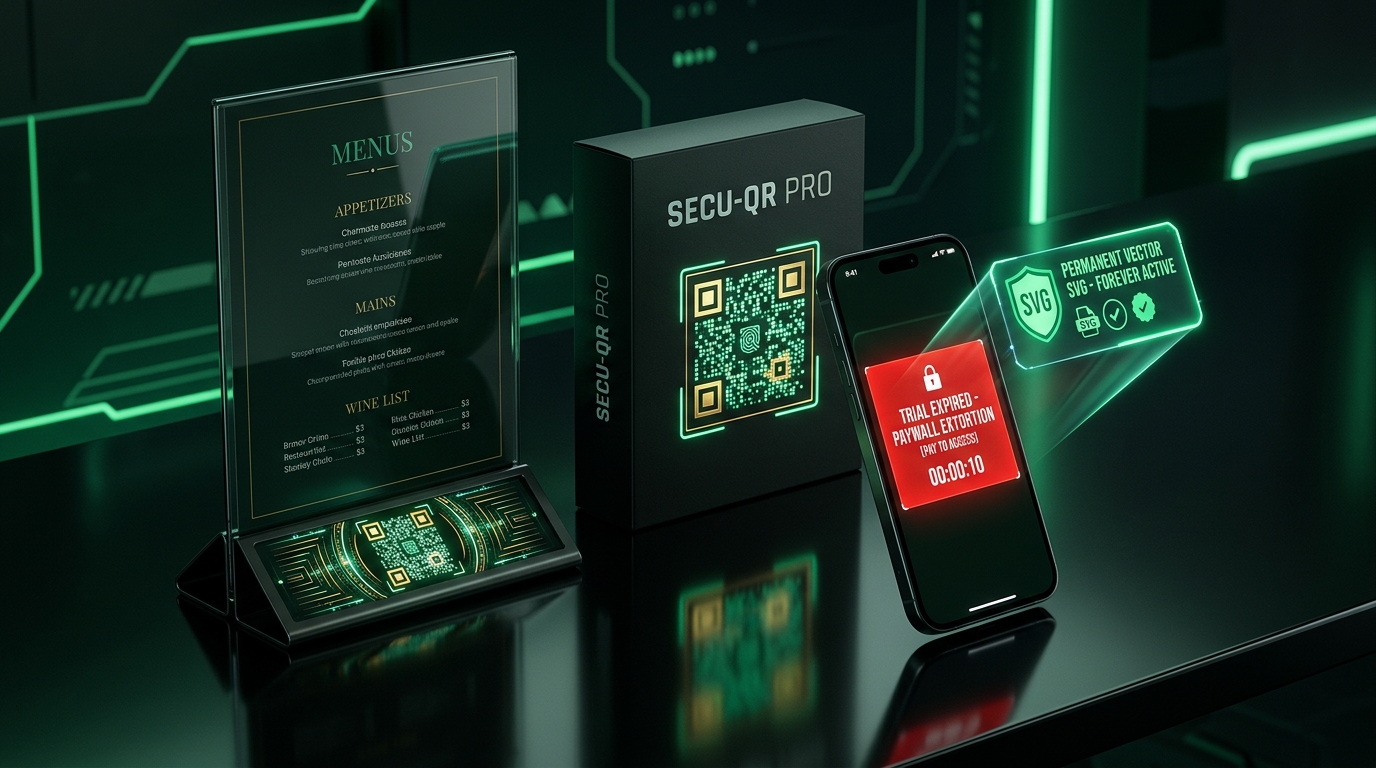
It is a nightmare playing out every single day across restaurants, retail brands, event organizers, and design agencies worldwide:
A boutique restaurant owner designs gorgeous new table standees and prints 5,000 physical menus featuring a sleek QR code labeled "Scan to View Wine & Food Menu".
For the first two weeks, everything works flawlessly. Customers scan, browse, and order.
Then, on Day 15, the restaurant’s phones start ringing. Waiters scramble as bewildered customers point their phone cameras at the table standees, only to be greeted by a glaring red error screen:
"This QR Code has reached its scan limit or the 14-Day Free Trial has expired. Please contact the account administrator to upgrade to our Business Pro Plan ($19.99/month) to reactivate your link."
The restaurant owner never signed up for a subscription. They typed "free qr code generator" into Google, clicked the top-ranking advertisement, downloaded what they believed was a free utility, and sent it to the commercial offset printer.
Now, thousands of dollars in printed marketing materials are completely useless—or worse, held hostage by a predatory monthly subscription.

1. The Anatomy of the 14-Day Dynamic QR Trap
To understand why this happens, you must understand the critical technical difference between two completely different types of QR codes: Static QR Codes and Dynamic QR Codes.
┌────────────────────────────────────────────────────────────────────────┐
│                   HOW THE DYNAMIC REDIRECT TRAP WORKS                  │
│                                                                        │
│  [ Printed QR Code ] ─── Encodes ───> https://qr-scam-saas.com/r/98a2f │
│                                                      │                 │
│                                                      ▼                 │
│                                           [ Middleman SaaS Server ]    │
│                                                      │                 │
│                 ┌────────────────────────────────────┴───────────────┐ │
│                 │                                                    │ │
│                 ▼                                                    ▼ │
│          [ Day 1 to 14 ]                                      [ Day 15+ ]      │
│     Redirects to Real Site:                              Paywall Lock Triggered:│
│    https://myrestaurant.com/menu                         "PAY $20/MO OR LINK DIES"│
└────────────────────────────────────────────────────────────────────────┘
The Technical Mechanism
When you generate a standard Static QR Code, your destination URL (e.g., https://yourbrand.com/offer) is directly baked into the black-and-white 2D matrix pattern itself using mathematical Reed-Solomon error correction algorithms. The camera decodes the pixels locally inside device RAM and immediately launches your browser to that address. There is zero server in between. It can never expire.
However, commercial "freemium" QR generators don't give you a direct static code. Instead, they generate a Dynamic Redirect Link pointing to their own server:
- Instead of encoding:
https://mybusiness.com - They encode:
https://freer-qr-tools-online.io/r/8f72c1
When anyone scans the code, their device hits the vendor's cloud server first. The vendor intercepts the traffic, logs the user's IP, device model, and GPS location, and then issues an HTTP 302 Temporary Redirect to your real website.
The Hostage Business Model
Because the printed QR code points to their domain, the vendor has full execution authority over the connection.
Once your marketing collateral, trade show banners, product boxes, or business cards are physically printed and distributed, you lose all leverage. You cannot "edit" physical paper.
At that exact moment, the vendor activates their paywall. You are faced with an agonizing dilemma:
- Pay $15 to $40 per month forever just to keep a URL redirect active; or
- Throw away thousands of dollars in printed inventory and re-print everything from scratch.
2. Dynamic Redirection Trap vs. Permanent Static Direct Vector
The following architectural diagram illustrates the structural vulnerability of commercial dynamic QR services compared to client-side, direct static encoding:
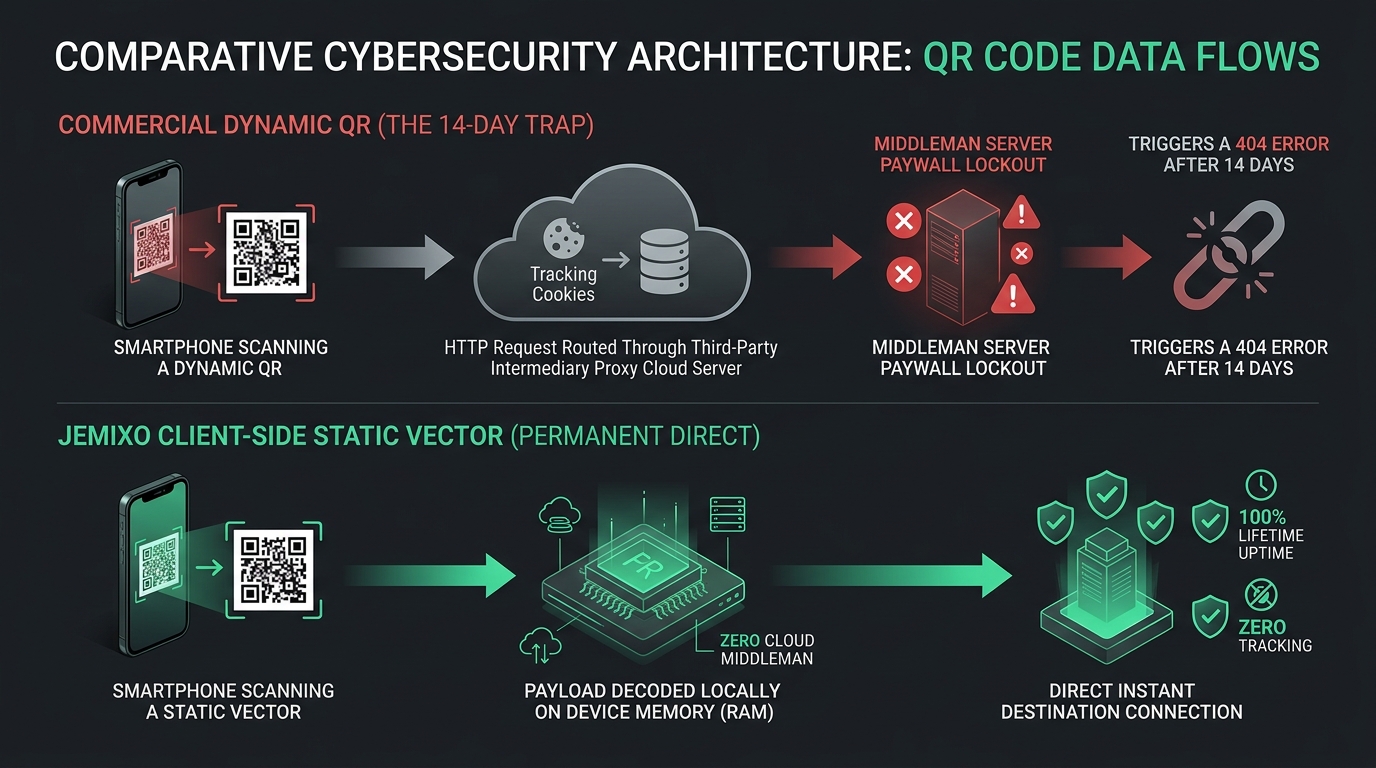
Here is a side-by-side technical comparison of how both architectures perform in real-world deployments:
| Engineering Parameter | Commercial "Freemium" Dynamic QR | Client-Side Static Vector QR (Jemixo) |
|---|---|---|
| Data Encoding | Encodes vendor middleman domain (/r/xyz) |
Encodes 100% direct payload directly in matrix |
| Expiration Date | 14–30 Days (or scan limit reached) | Permanent (Never expires forever) |
| Middleman Server Dependency | Requires 100% vendor server uptime | Zero server dependency (Works offline) |
| Data Privacy & Tracking | Intercepts user IP, device agent & cookies | Zero tracking (100% Client-side RAM execution) |
| Cost Over 3 Years | $540 – $1,440 in forced subscriptions | $0.00 (Completely Free) |
| Vector SVG Support | Usually locked behind Pro tier ($25+/mo) | Included Free (Lossless vector export) |
| Risk of Malicious Hijack | High (Vendor can redirect scans if unpaid) | Zero (Code is mathematically immutable) |
3. Beyond Paywalls: The Privacy & Cybersecurity Threat ("Quishing")
The dangers of third-party dynamic QR middleman servers extend far beyond unexpected subscription charges. In 2026, enterprise security teams and cybersecurity agencies classify unvetted dynamic QR generators as a significant vector for Quishing (QR Phishing) and data exfiltration.
graph TD
    A[Customer Scans Vendor Dynamic QR] --> B[Third-Party Proxy Server]
    B --> C{Vendor Monetization Pipeline}
    C -->|1. Tracking| D[User IP, Location & Device Fingerprint Harvested]
    C -->|2. Script Infiltration| E[Ad Trackers & Meta Pixels Injected into Transit]
    C -->|3. Domain Expiration / Hijack| F[Future Risk: Domain Sold to Phishers]
    C -->|4. Expired State| G[Malicious Popups & Extortion Paywall Screen]
1. Covert Ad Trackers & Cross-Site Fingerprinting
When a customer scans a dynamic QR code on your product packaging, the intermediary server drops tracking cookies, extracts canvas fingerprints, and logs their precise geocoordinates before redirecting them to your website. Many freemium QR websites monetize this behavioral traffic by selling syndicated analytics to data broker networks.
2. Domain Expiry & Phishing Hijack Risks
What happens if the freemium QR generator startup shuts down, goes bankrupt, or lets their domain name expire three years from now? Rogue domain squatters and cybercrime syndicates routinely buy expired domains of abandoned QR services. Overnight, every QR code you ever printed on products, machinery instruction labels, or museum plaques begins redirecting unsuspecting customers to malware downloads, banking phishing portals, or adult scam websites.
3. When You ACTUALLY Need Dynamic vs. When You MUST Use Static
Dynamic QR codes have legitimate enterprise applications (e.g., multinational billboard campaigns that need to rotate seasonal landing pages weekly without changing physical signage).
However, for 95% of everyday use cases:
- Restaurant Menus & Table Ordering ➔ Should ALWAYS be Static.
- Wi-Fi Network Auto-Connect ➔ MUST be Static (IEEE 802.11 standard cannot route through cloud URLs).
- vCard Digital Business Cards ➔ MUST be Static (directly opens native iOS/Android phonebook).
- Product Packaging & Instruction Manuals ➔ Should ALWAYS be Static.
- WhatsApp / SMS Pre-filled Chat Links ➔ Should ALWAYS be Static.
- Crypto Wallet Payment Addresses ➔ MUST be Static (zero intermediary risk).
4. The Vector SVG Difference: Why Raster PNGs Ruin Print Jobs
The second most common disaster in commercial QR printing is resolution degradation.
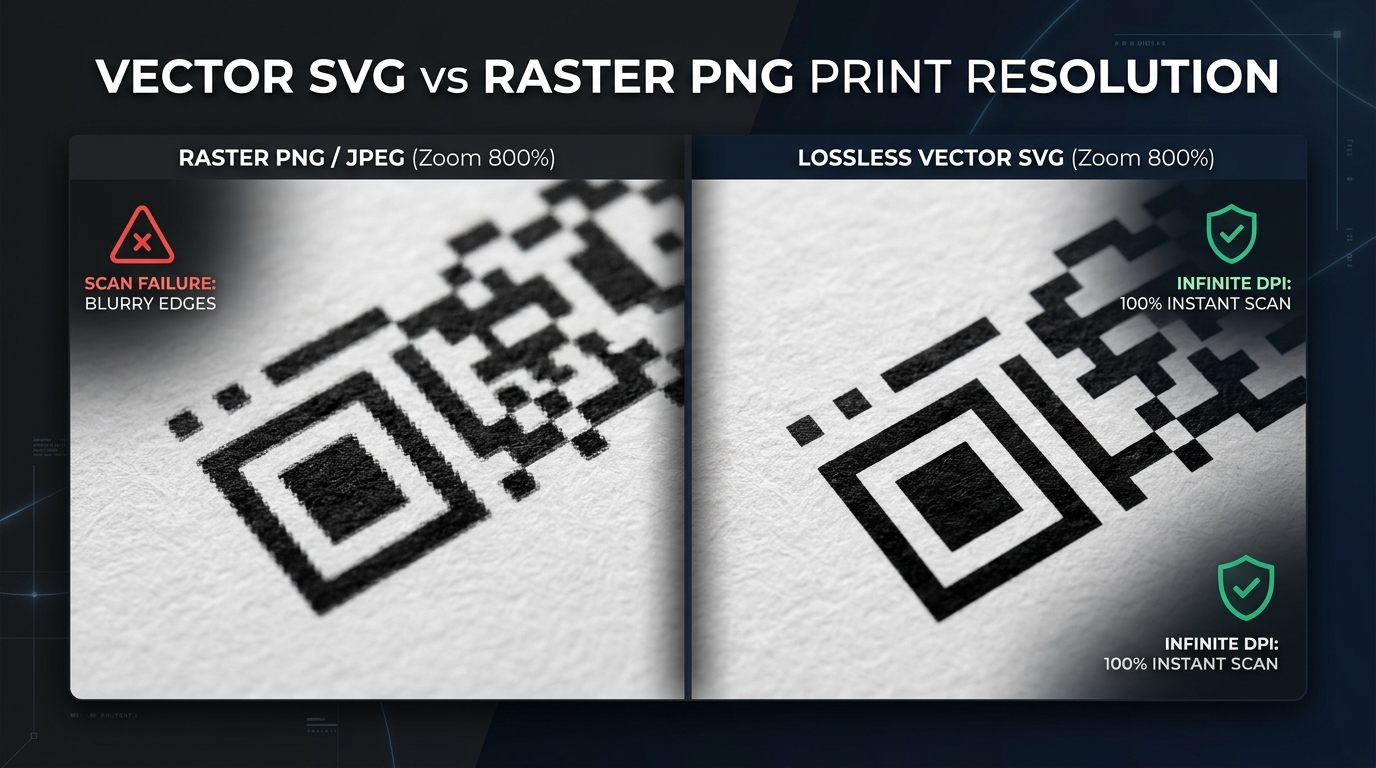
Most online tools only provide low-resolution raster images (.PNG or .JPG at 72 or 150 DPI). When a graphic designer or commercial offset printer places a 300px PNG onto an A4 flyer, a vinyl rollup banner, or a storefront window decal, the printer software must interpolate pixels:
Why Raster PNG/JPG Fails at Print Scale:
- Jagged Anti-Aliased Edges: Raster images are composed of a rigid grid of pixels. When magnified, the corners of the QR code dots blur into shades of gray. Smartphone cameras rely on high-contrast contrast boundary transitions; blurry edges increase optical scanning failure rates by up to 65%, especially in dim restaurant lighting.
- Ink Bleed on Physical Paper: Offset and flexographic printing presses naturally cause a micro-amount of ink bleeding into paper fibers. If the digital file is already fuzzy and pixelated, adjacent dots bleed into one another, destroying the QR code's error correction tolerance.
Why Lossless Vector SVG is Non-Negotiable:
- Mathematical Precision: SVG (Scalable Vector Graphics) does not store pixels. It stores geometric coordinates (
<rect>,<path>,<circle>). Whether printed on a 1-inch stamp or an 80-foot highway billboard, the edges remain mathematically razor-sharp at infinite DPI. - Direct Adobe Illustrator & Figma Compatibility: Vector SVGs can be imported directly into prepress workflows without color degradation or rasterization artifacts.
5. How to Create Permanent, Branded Vector QR Codes in 2026 (Free & Private)
To liberate creators, small businesses, and agencies from subscription extortion traps, Jemixo engineered the Custom QR Code Generator & Studio (https://jemixo.com/tools/qr-code-generator).
It operates on a zero-compromise architectural philosophy:
- 100% Client-Side In-Memory Execution: The mathematical QR matrix generation and visual styling engine run entirely inside your browser memory using hardware-accelerated Canvas and SVG DOM trees. Your URLs, Wi-Fi credentials, and phone numbers are never transmitted to any external server.
- Permanent Static Guarantee: Every single QR code generated is direct and static. There are no redirects, no scan counters that shut off, no middleman domains, and no expiration dates.
- Lossless Vector SVG Export: Download true vector
.SVGfiles ready for professional prepress CMYK printing, alongside ultra-high-resolution 2048px PNGs and print-formatted A4 PDF layouts. - Custom Studio Aesthetics: Seamlessly upload custom brand logos, configure modern eye-corner shapes (extra-rounded, dots, smooth), and blend smooth linear and radial color gradients.
┌────────────────────────────────────────────────────────────────────────┐
│              STEP-BY-STEP WORKFLOW TO PERMANENT PRINT SUCCESS          │
│                                                                        │
│  [ Step 1: Select Type ]  ──> Choose URL, Wi-Fi, vCard or WhatsApp     │
│  [ Step 2: Customize ]    ──> Pick Brand Colors & Upload Center Logo    │
│  [ Step 3: Set ECC to H ] ──> 30% Error Correction for Logo Tolerance   │
│  [ Step 4: Export Vector ]──> Download .SVG for Commercial Print        │
└────────────────────────────────────────────────────────────────────────┘
Pro Tip for Logo Integration:
When embedding a company logo into the center of a QR code, always set the Error Correction Level to 'H' (High - 30%). This ensures that up to 30% of the QR matrix data can be obscured by your logo while maintaining instant, effortless smartphone scanning across all lighting conditions.
Frequently Asked Questions
Why do commercial QR generators claim dynamic QR codes are "better"?
Commercial vendors promote dynamic QR codes because it creates vendor lock-in. While dynamic codes allow you to change the destination URL after printing, freemium services use this architectural middleman to enforce recurring subscriptions. If your destination URL does not need to change frequently (like your homepage, permanent menu link, or Wi-Fi login), a static code is vastly superior, faster, and 100% free forever.
Can a static QR code ever stop working?
No. A static QR code has no expiration date because the data is encoded directly into the physical matrix pattern. As long as the destination URL on your website is live and the printed code remains physically legible, the QR code will function 10, 20, or 50 years from now.
What is the minimum physical size I should print a QR code?
For business cards and brochures scanned from 6 to 12 inches away, the recommended minimum physical size is 2 cm × 2 cm (0.8 inches × 0.8 inches). For posters and storefront windows scanned from 3 to 6 feet away, print at least 10 cm × 10 cm (4 inches × 4 inches). Always test-scan physical print proofs with both iOS and Android cameras before commencing high-volume commercial print runs.
Does Jemixo charge any fee or add watermarks to downloaded SVG files?
No. All tools in the Jemixo Web Suite are 100% free with zero watermarks, zero subscription tiers, and no sign-up requirements.
Need to generate a permanent, print-ready QR code for your brand? Use our free Custom QR Code Generator & Studio to export lossless vector SVG and ultra-sharp 2048px PNG files today.