"We need microservices because we plan to scale to millions of users."
In over a decade of architecting SaaS systems and advising early-stage technical founders, I have heard this exact sentence dozens of times. It is almost always spoken with conviction, often backed by architectural diagrams borrowed from Netflix, Uber, or Amazon blog posts.
And in nearly every instance, it is the wrong architectural decision.
When founders and engineering leads jump straight into microservices before having paying customers, product-market fit, or an engineering team larger than five people, they aren't buying insurance against future scaling problems. They are buying immediate operational complexity, slow feature iteration, fragile distributed failure modes, and inflated cloud bills.
The real engineering questions every founder and CTO should ask in 2026 are:
- What exactly are you scaling? Is it compute throughput, database writes, async background tasks, or team headcount?
- How many concurrent users do you actually handle right now?
- How large is your current engineering team? Can you afford dedicated DevOps engineers just to manage service meshes and distributed tracing?
- Are your business domain boundaries genuinely stable? (If your product requirements change next Tuesday, refactoring across 8 microservices is painful).
- Can your business afford the operational tax of distributed systems before generating predictable revenue?
This guide offers an architectural reality check for 2026. We will explore why a well-designed Modular Monolith is frequently the smarter, more profitable foundation for modern SaaS products, examine the concrete scenarios where microservices genuinely earn their keep, and outline a practical migration blueprint for when your scale truly demands it.
What Is a Modular Monolith?
A Modular Monolith is an architectural pattern where an entire system runs as a single deployable artifact, but its internal structure is rigorously partitioned into independent, decoupled business domains with explicit interfaces.
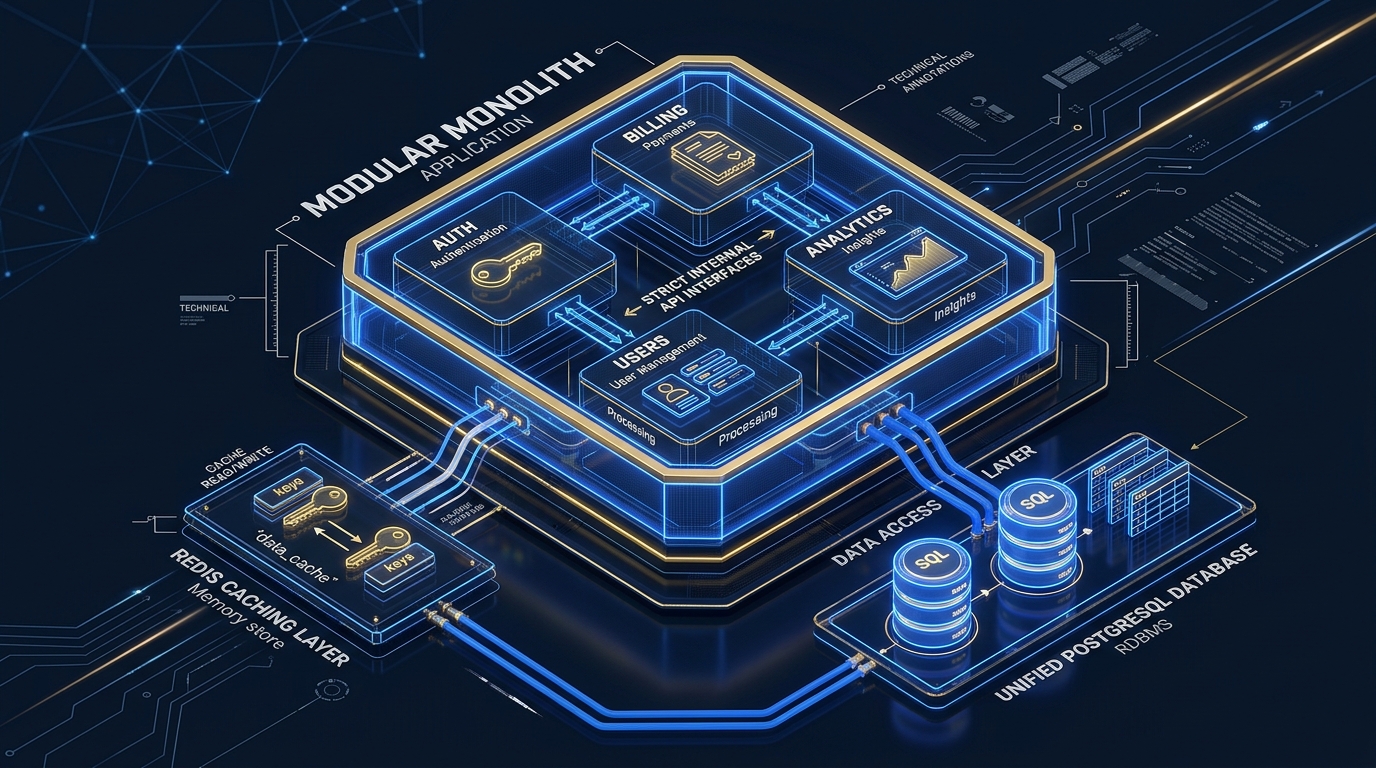
Many developers mistake "monolith" for the dreaded "Big Ball of Mud"—a chaotic tangle of spaghetti code where any file imports any other file, controllers run 800-line database queries directly, and changing an invoice status breaks user authentication.
A modular monolith is the polar opposite of spaghetti. It enforces architectural discipline:
- Single Deployment Unit: One repository (or workspace), one CI/CD pipeline, and one process or container running in production.
- Strict Domain Boundaries: Code is organized by business domain (
Billing,Auth,Tenants,Analytics), not by technical layer (controllers,models,views). - Encapsulated Data Models: Each module owns its internal tables and business logic. The
Billingmodule cannot execute direct SQL queries against theUserstable; it must communicate via an exposed public interface or domain service contract. - In-Process Communication: Modules communicate via simple in-memory function calls, TypeScript interfaces, or local event buses—incurring zero network latency, zero serialization overhead, and zero distributed transaction nightmares.
- Shared Infrastructure Where Appropriate: A unified, rock-solid relational database (like PostgreSQL) and a single Redis instance handle caching and background queues.
A Practical Codebase Structure
Here is how a production modular monolith looks in a modern TypeScript / Node.js or Laravel project:
src/
├── modules/
│   ├── identity/                 # Authentication, OAuth, API Keys
│   │   ├── api/                  # Public contract & exposed interfaces
│   │   ├── internal/             # Private business logic & repositories
│   │   └── identity.module.ts
│   │
│   ├── organizations/            # Multi-tenancy, Workspaces, Members
│   │   ├── api/
│   │   └── internal/
│   │
│   ├── billing/                  # Stripe/Razorpay, Subscriptions, Invoices
│   │   ├── api/
│   │   └── internal/
│   │
│   ├── projects/                 # Core domain product logic
│   │   ├── api/
│   │   └── internal/
│   │
│   └── notifications/            # Email, SMS, Webhooks, Push notifications
│       ├── api/
│       └── internal/
│
├── shared/                       # Cross-cutting primitives only
│   ├── database/                 # Prisma/TypeORM/Eloquent connection pooling
│   ├── cache/                    # Redis client & key managers
│   └── logger/                   # Structured logging (Pino / Winston)
│
└── main.ts                       # Single entrypoint & HTTP server
If the Projects module needs to check whether an organization has an active paid subscription, it does not query billing_subscriptions directly. It calls BillingService.hasActivePlan(orgId).
This clean boundary means that if you ever need to carve Billing into an external service three years from now, you can extract it cleanly in days instead of months of rewrite.
What Are Microservices?
A Microservices Architecture decomposes an application into a collection of small, independently deployable services, each running in its own process and communicating over network protocols (HTTP REST, gRPC, or asynchronous message brokers like Apache Kafka or RabbitMQ).
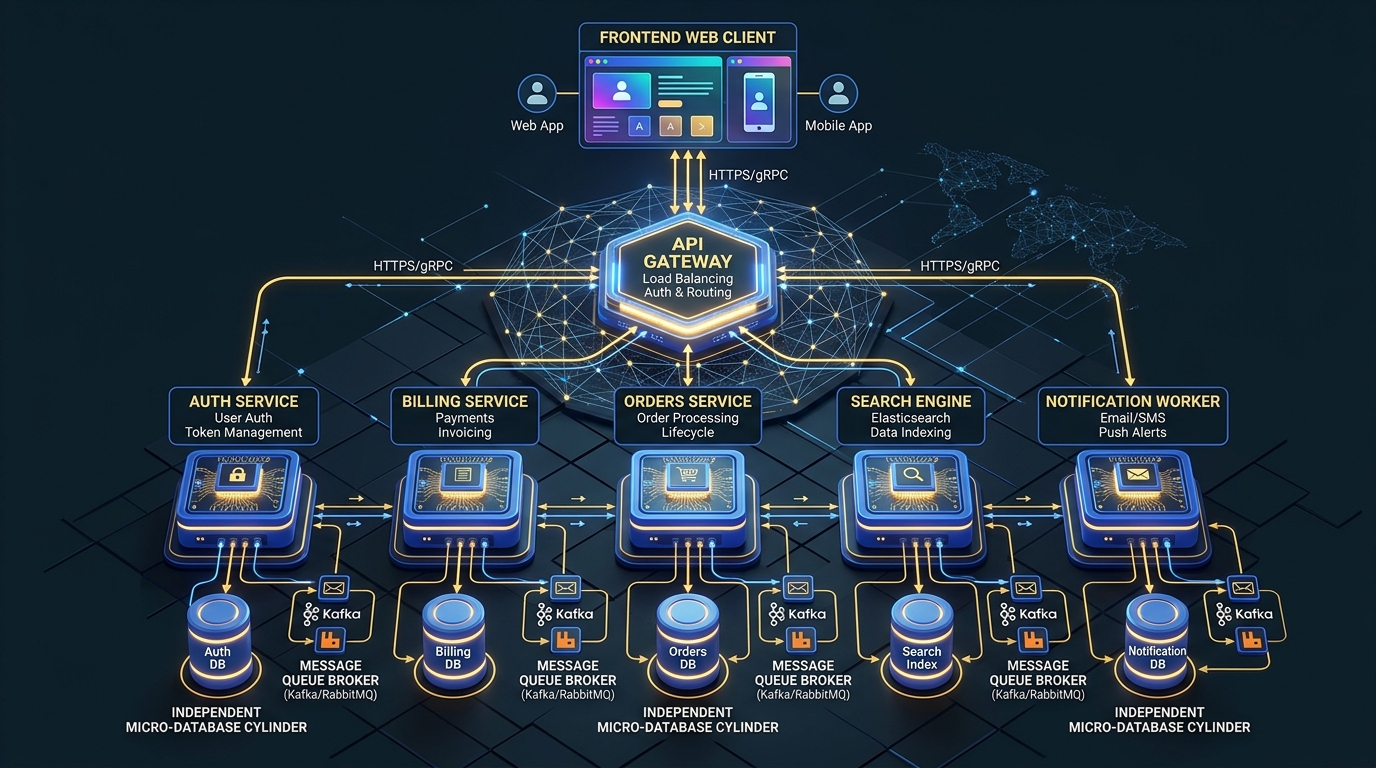
In a pure microservices paradigm:
- Independent Deployment: A change to the
Notification Servicedoes not require redeploying theBilling Service. - Database per Service: Each service owns its private database. The
Billing Servicecannot access theUser DBunder any circumstances; all data access happens over the network. - Contract-Driven Communication: Teams establish API contracts using OpenAPI or Protocol Buffers.
- Decentralized Governance: Different services can theoretically use different languages or frameworks (e.g., Python for AI ingestion, Go for real-time WebSockets, TypeScript for CRUD APIs).
- Independent Scaling: If notification traffic spikes 50x during a marketing blast, only the notification containers scale up.
On paper, this sounds pristine. In reality, microservices trade code complexity for distributed systems operational complexity.
Modular Monolith vs. Microservices: The 2026 Comparison
Here is an honest, production-tested comparison across the critical dimensions of SaaS engineering:
| Dimension | Modular Monolith | Microservices Architecture |
|---|---|---|
| Initial Time to Market | Very Fast. Single codebase, straightforward scaffolding. | Slow. Requires API gateways, service discovery, CI pipelines per service. |
| Deployment Complexity | Trivial. 1 Docker image, 1 health check, standard rolling deploy. | High. Coordinated deployments, container orchestration (Kubernetes), Helm charts. |
| Infrastructure Overhead | Minimal. Single cluster or VPS, shared PostgreSQL + Redis. | High. Multiple container pools, message brokers, service meshes, VPC peering. |
| Debugging & Observability | Straightforward. Single stack trace with line numbers in Sentry/Datadog. | Complex. Distributed tracing (OpenTelemetry, Jaeger), correlation IDs across hops. |
| Data Consistency | ACID Transactions. BEGIN ... COMMIT handles cross-table atomic updates. |
Eventual Consistency. Requires Saga patterns, outbox patterns, compensating workflows. |
| Network Latency | Microseconds. Function calls execute directly in CPU memory. | Milliseconds. Serialization, TLS handshakes, network hops, DNS lookups. |
| Local Development | Run npm run dev or docker compose up on any standard MacBook. |
Requires 16GB+ RAM to run 12 local containers, mocks, or ephemeral cloud environments. |
| Refactoring Boundaries | Fast. IDE rename refactoring updates signatures across modules instantly. | Painful. Breaking changes require semantic versioning, deprecation periods, dual-running APIs. |
| Testing | Simple unit, integration, and E2E tests run in a single GitHub Actions job in <4 minutes. | Complex contract testing (Pact), staging environments, or multi-repo integration suites. |
| Failure Modes | Predictable. Unhandled exceptions are isolated by process or try/catch. | Cascading network timeouts, retry storms, circuit breakers, dead-letter queues. |
| Team Size Fit | 1 to 25 engineers. | 30+ engineers across multiple autonomous squads. |
| Monthly Operational Cost | ₹5,000 – ₹35,000 ($60 – $400/mo) handles substantial traffic. | ₹50,000 – ₹3,00,000+ ($600 – $4,000+/mo) just for baseline idle infrastructure. |
The Biggest Myth: "Microservices = Scalability"
The single most pervasive misconception among startup founders is equating microservices with scalability.
Microservices do not make your software fast. In fact, on a per-request basis, microservices are measurably slower than monoliths because network hops take significantly longer than in-memory function calls.
When an application slows down under load, 95% of the time the bottleneck is not the monolithic code structure. The bottlenecks are:
- Unoptimized Database Queries: Missing indexes, N+1 query loops, and full table scans.
- Lack of Caching: Hitting the primary database repeatedly for data that changes once a week.
- Synchronous Blocking Work: Sending welcome emails, generating PDFs, or resizing images in the middle of an HTTP request cycle.
- Poor Connection Pooling: Exhausting database connections under traffic spikes.
- Static Assets on Web Servers: Serving images and JS bundles from the application server instead of a global CDN (Cloudflare / CloudFront).
None of these issues are solved by microservices. In fact, dividing an application into 10 services makes database connection pooling and query optimization harder, not easier.
How Far Can a Modular Monolith Actually Scale?
With modern cloud hardware, a well-architected modular monolith backed by PostgreSQL and Redis can handle astonishing scale:
- Shopify: Runs one of the largest Ruby on Rails modular monoliths on Earth, processing over $10 billion in Black Friday transactions across millions of requests per minute.
- GitHub: Operated as a monolithic Rails application for over a decade through hundreds of millions of developers and git pushes.
- Basecamp / 37signals: Famously left the public cloud, running high-concurrency SaaS platforms on monolithic architectures running on owned hardware with minimal operations staff.
- Stack Overflow: Served hundreds of millions of monthly pageviews for years from just a handful of monolithic web servers and one master SQL Server.
If your SaaS has under 500,000 active users, your modular monolith is not your scaling limit. Proper database indexing, Redis caching, read replicas, and stateless horizontal scaling will take you further than you can imagine.
The Hidden Operational Tax of Microservices
Before choosing microservices, founders must understand the distributed systems tax—the unavoidable engineering overhead required just to keep the lights on:
The Distributed Systems Tax
├── Service Discovery (Consul / CoreDNS)
├── Distributed Tracing (OpenTelemetry / Jaeger)
├── Log Aggregation (Elasticsearch / Loki)
├── API Gateway & Rate Limiting (Kong / Envoy)
├── Network Security (mTLS / Service Mesh / Istio)
├── Distributed State (Kafka / RabbitMQ / SQS)
├── Data Consistency (Saga Orchestration / Outbox Pattern)
└── Infrastructure as Code (Terraform / Helm / Kubernetes)
Consider a simple user registration flow:
In a Modular Monolith:
await db.transaction(async (trx) => {
  const user = await trx.users.create({ email, passwordHash });
  const tenant = await trx.tenants.create({ name, ownerId: user.id });
  await trx.subscriptions.createFreeTrial({ tenantId: tenant.id });
});
// If anything fails, database rolls back automatically. Zero data corruption.
In Microservices:
- API Gateway routes to
Auth Service→ creates user. Auth ServiceemitsUserCreatedevent to Kafka broker.Organization Serviceconsumes event → attempts to create workspace. What if its database connection times out?Billing Serviceconsumes event → attempts to initialize free trial. What if Stripe's webhook fails?- Now you need a Saga Orchestrator to trigger compensating transactions: delete the orphaned workspace, send a rollback message to
Auth Serviceto mark the user as failed, and handle edge cases where the rollback itself fails.
To build and maintain this reliably, you need dedicated Site Reliability Engineers (SREs). For an early-stage startup or growing SaaS, spending 40% of your engineering budget on infrastructure plumbing instead of shipping user-facing features is lethal.
Why a Modular Monolith Is the Smarter Choice for Startups
For seed, bootstrapped, and Series-A SaaS companies, business agility is the only moat that matters. Here is why the modular monolith wins on business grounds:
1. Velocity of Product Iteration
In early SaaS development, product requirements change weekly. In a modular monolith, reshaping a domain boundary requires refactoring code in one repository. In microservices, it requires coordinating changes across multiple repositories, managing backward-compatible API versions, and running multi-service deployment sequences.
2. Radical Debugging Simplicity
When an error occurs in a modular monolith, you get a single deterministic stack trace in Sentry or your logs showing the exact file, class, and line number where execution failed. In microservices, diagnosing why a customer was charged twice might require tracing a correlation ID across five microservices, two message queues, and an asynchronous worker pool.
3. Frictionless Local Development
A new engineer joining your team can clone the repository, run cp .env.example .env, launch docker compose up for PostgreSQL and Redis, and start coding in 15 minutes. They don't need a 32GB RAM workstation or complex local Kubernetes clusters (Minikube / Kind) just to run the login flow.
4. Zero Network Failure Modes Between Internal Domains
Within a monolith, method invocations do not fail due to transient DNS hiccups, TLS negotiation timeouts, dropped packets, or routing misconfigurations. Communication is instant and deterministic.
5. Unified CI/CD Pipeline
One test suite. One build step. One container push. Pull requests are validated in 3 to 5 minutes, allowing your engineering team to ship updates to production 10 to 20 times a day with total confidence.
When Microservices Actually Make Sense
Microservices are not inherently flawed—they are an advanced organizational solution for an advanced organizational problem.
Microservices become the right choice when your company reaches specific inflection points:
1. Team Headcount Exceeds Conway’s Law
When you have 40 to 100+ engineers, having everyone commit to a single monolithic repository can create friction: merge conflicts, test suite bottlenecks, and deployment queues where one engineer's broken test blocks 30 other developers from deploying. Microservices allow independent engineering squads (e.g., the "Checkout Squad" vs. the "Fraud Squad") to own their own code, deploy independently, and choose release cadences without coordinating with 50 other people.
2. Genuinely Asymmetric Workload Demands
If 98% of your SaaS application performs standard CRUD operations, but 2% does heavy GPU-based machine learning inference, real-time video transcoding, or massive WebSocket connection management (100,000 persistent connections), it makes sense to extract that specific workload into its own microservice so it can scale horizontally on specialized hardware without replicating the entire web application.
3. Different Regulatory or Compliance Isolation
If a specific part of your application handles PCI-DSS Level 1 credit card processing or sensitive HIPAA health records, carving that module into a strictly isolated, auditable microservice can dramatically reduce the compliance audit perimeter for the rest of your platform.
4. Radically Different Technology Stacks
If your core SaaS is built in Next.js and TypeScript, but your data pipeline requires Apache Spark and Python, running the data pipeline as an independent service with its own runtime is completely natural.
When You Should NOT Use Microservices (The Checklist)
If you check any of the following boxes, do not build microservices:
- You have fewer than 20 engineers.
- You have not achieved clear product-market fit or predictable monthly recurring revenue.
- Your domain models and feature specs are still actively pivoting based on customer feedback.
- You do not have at least one dedicated, experienced DevOps/SRE engineer on payroll.
- You cannot clearly articulate which specific module will crash your database if left inside the monolith.
- Your primary motivation is "because Uber / Netflix does it" or "it looks good on our engineering resumes."
The 1,000 → 1M User SaaS Architecture Evolution Model
Architecture is not a static decision; it is a progressive evolution. Here is how pragmatic SaaS companies evolve their infrastructure as their business grows:
SaaS Architecture Evolution Lifecycle

Stage 1: 1 - 1,000 Users
└── Single Modular Monolith + Managed PostgreSQL + Single Redis + Cloudflare CDN

Stage 2: 1,000 - 10,000 Users
└── Modular Monolith + Background Worker Pool + Read Replica + Aggressive Redis Caching

Stage 3: 10,000 - 100,000 Users
└── Horizontal Monolith Replicas + Separate Async Queue Cluster + Managed Vector DB (AI)

Stage 4: 100,000 - 1M+ Users
└── Core Monolith + Selectively Extracted High-Load Services (Strangler Pattern)
Stage 1: The Early SaaS (1 – 1,000 Users)
- Goal: Maximum product iteration speed and minimum hosting bill.
- Stack: Modular Monolith (Next.js / Node.js or Laravel), managed PostgreSQL (Supabase / AWS RDS / DigitalOcean Managed DB), Redis for sessions and queues, Cloudflare for DNS & CDN.
- Operational Burden: Zero dedicated DevOps. Single digital server or PaaS (Render / Railway / Fly.io / AWS ECS).
Stage 2: The Growing SaaS (1,000 – 10,000 Users)
- Goal: Reliability and response time consistency under daily active traffic.
- Enhancements: Split the web server and background job worker into two separate processes running the same codebase. Introduce a PostgreSQL Read Replica for heavy analytical reporting. Use Redis caching for frequently read configuration data.
- Operational Burden: 1–2 hours of monitoring review per week.
Stage 3: High Growth (10,000 – 100,000 Users)
- Goal: Throughput and resilience during traffic spikes.
- Enhancements: Run multiple stateless copies of the modular monolith behind an Application Load Balancer (ALB). Introduce dedicated BullMQ / Sidekiq worker pools for email dispatch, file processing, and webhook delivery. Add OpenTelemetry tracing and structured APM logging (Datadog / New Relic).
- Architecture: Still 100% a modular monolith!
Stage 4: Large Scale Enterprise (100,000 – 1M+ Users)
- Goal: Autonomous team velocity and specialized scaling.
- Enhancements: You identify that one specific domain—say, real-time IoT event ingestion or AI embeddings processing—is consuming 85% of CPU cycles or requires weekly schema migrations. You extract only that module into an independent service using the Strangler Pattern, leaving the rest of the application stable inside the core monolith.
The Strangler Pattern: How to Safely Transition
If your SaaS does eventually reach massive scale, you do not need to pause feature development for nine months to execute a high-risk "ground-up microservices rewrite."
Instead, use the Strangler Fig Pattern:
The Strangler Fig Migration Pattern

Step 1: Modular Monolith in Production (Clean Module Boundary)
             │
Step 2: Place an API Gateway (Kong / Cloudflare Workers) in front
             │
Step 3: Build the new microservice for ONLY the bottleneck domain
             │
Step 4: Route 5% of traffic to the new service via Gateway (Canary)
             │
Step 5: Verify parity, error rates, and database synchronization
             │
Step 6: Shift 100% of traffic for that route to the new microservice
             │
Step 7: Deprecate the old module inside the monolith
Because your monolith was designed modularly from Day One with strict internal API interfaces, extracting that module into an external service is a disciplined refactoring exercise rather than an architectural catastrophe.
Production Blueprint: The 2026 Modern SaaS Architecture
Here is the battle-tested, high-performance architecture we build and recommend for modern SaaS products in 2026:
                             [ Users / Clients ]
                                      │
                                      ▼
                       [ Cloudflare CDN & WAF / DDoS ]
                                      │
                                      ▼
                      [ AWS ALB / Reverse Proxy (Nginx) ]
                                      │
       ┌──────────────────────────────┴──────────────────────────────┐
       ▼                                                             ▼
[ Web App Container: Next.js / Node ]              [ Async Background Workers ]
├── Modules: Auth, Tenants, Billing                ├── BullMQ / Redis-backed
├── Modules: Core Domain Logic                     ├── Email / Webhook delivery
└── Strict In-Memory Domain Interfaces             └── Report generation / Cleanup
       │                                                             │
       ├──────────────────────────────┬──────────────────────────────┤
       ▼                              ▼                              ▼
[ PostgreSQL Cluster ]         [ Redis Cluster ]          [ Cloud Object Storage ]
├── Primary (Read/Write)       ├── Session Cache          └── AWS S3 / Cloudflare R2
└── Read Replica (Reports)     ├── Queues & Rate Limits       (User uploads, invoices)
                               └── Pub/Sub Real-time
The Recommended 2026 Tech Stack:
- Frontend / Fullstack: Next.js (React 19, TypeScript, Server Components) or clean Vue/Nuxt.
- Backend Core: Node.js (Fastify / Express / NestJS with TypeScript) or Laravel (PHP 8.3+) for unbeatable rapid SaaS development.
- Database: PostgreSQL (with
pgvectorfor AI similarity search). - Caching & Async Queues: Redis (managed via Upstash, AWS ElastiCache, or Redis Cloud).
- Storage: Cloudflare R2 or AWS S3 with signed URLs.
- Authentication: Turnkey identity (Clerk / Auth0 / Supabase Auth) or robust internal JWT/Session modules.
- Payments: Stripe Billing or Razorpay with idempotent webhook handlers.
This stack comfortably handles millions of database records and hundreds of requests per second for a few hundred dollars a month.
How Modern AI Changes the Architecture Conversation
Artificial Intelligence is the defining SaaS capability of 2026. But AI introduces architectural challenges: high inference latency (2 to 15 seconds per call), streaming token responses, vector embeddings, and non-deterministic outputs.
Does AI require a microservices architecture? No. But it does favor a decoupled worker pattern.
Modular Monolith Core
       │
       ├── User Management
       ├── Workspace & Permissions
       ├── Subscription Billing
       └── Project Workspaces
              │
              │ (Async Job Dispatch via Redis / BullMQ)
              ▼
       [ AI Worker Service ]
              │
              ├── LangChain / LlamaIndex / Custom Agent Runner
              ├── Embedding Generation
              ├── Vector Database (pgvector / Pinecone / Qdrant)
              └── External LLM APIs (OpenAI / Anthropic / Gemini)
In this hybrid setup:
- Your core business logic remains inside the fast, reliable modular monolith.
- AI tasks (document ingestion, RAG vector searches, automated agent workflows) run asynchronously via dedicated workers.
- The web client receives instant HTTP acknowledgments, and AI results stream over WebSockets or Server-Sent Events (SSE).
You get all the benefits of specialized AI processing without blowing up your core application architecture into 15 microservices.
The 10-Question SaaS Architecture Test
Before writing a single line of architecture code, run your product through this 10-question evaluation:
- How many full-time backend/DevOps engineers will maintain this system in Year 1?
(<5 → Monolith | 5–25 → Modular Monolith | >30 → Consider Microservices) - Has the core business model achieved validated product-market fit?
(No → Modular Monolith | Yes → Evaluate bottlenecks) - Do different business features require fundamentally different deployment cycles?
(No → Monolith | Yes → Hybrid) - Do you have specialized workloads requiring unique hardware (e.g., GPU clusters)?
(No → Monolith | Yes → Extract only that specific worker) - Can your product tolerate the eventual consistency of distributed databases?
(Financial/billing systems usually cannot without immense custom engineering) - What is your target time-to-market for the MVP or v1 release?
(<3 months → Modular Monolith is mandatory) - Does your team have real production experience with distributed tracing and Kafka?
(No → Avoid microservices at all costs) - Are your domain boundaries rock-solid and agreed upon across the entire business?
(In early startups, boundaries change continuously) - Can the startup afford $1,000–$3,000/month in baseline cloud DevOps infrastructure before launch?
(No → Monolith) - Would an outage in feature X (e.g., notifications) being isolated from feature Y (e.g., login) justify 3x development time?
The Scoring Verdict:
- 8–10 points for Monolith: Build a clean Modular Monolith. Anything else is wasteful overengineering.
- 4–7 points: Build a Modular Monolith with extracted asynchronous workers (Hybrid).
- 0–3 points: Your organizational size and asymmetric throughput justify a Microservices architecture.
Architecture Decision Matrix
| Your Product Stage / Situation | Recommended Architecture | Primary Rationale |
|---|---|---|
| New SaaS Startup (Pre-revenue / MVP) | Modular Monolith | Maximize iteration velocity; zero operational overhead. |
| Small Engineering Team (1–10 devs) | Modular Monolith | Keep the whole team focused on shipping customer value. |
| High Feature Churn / Early Traction | Modular Monolith | Refactoring across internal boundaries is effortless. |
| SaaS with Heavy AI / Media Processing | Modular Monolith + AI Workers | Isolate long-running compute jobs without fragmenting the database. |
| Mid-Market SaaS (10K–100K users) | Scaled Modular Monolith | Read replicas, caching, and horizontal pods easily handle this load. |
| Multi-Squad Organization (40+ engineers) | Selective Microservices | Solves Conway’s law bottlenecks around code ownership. |
| Global Enterprise with Independent Business Units | Full Microservices | Autonomous deployments and regulatory data residency requirements. |
10 Common SaaS Architecture Mistakes to Avoid
- Premature Microservices: Building 12 microservices for a product with 120 users.
- Premature Kubernetes: Spending three months configuring Helm charts, Ingress controllers, and persistent volume claims instead of onboarding beta customers.
- The Shared Database Anti-Pattern: Building "microservices" that all connect to the exact same MySQL database. This gives you all the network latency of microservices with all the coupling of a monolith—the worst of both worlds.
- Spaghetti Monoliths: Failing to enforce modular boundaries inside a monolith, turning it into an unmaintainable codebase within 18 months.
- No Structured Observability: Relying on
console.loginstead of centralized APM tools and structured JSON logs. - Sync HTTP Chains: Service A calls Service B, which calls Service C, which calls Service D. If Service C hiccups, the entire cascade times out.
- Ignoring Connection Pooling: Letting serverless functions or worker instances exhaust PostgreSQL connections under load.
- Overengineering for Hypothetical Scale: Designing for 10 million users when you haven't validated that 10 people will pay for the product.
- Rewriting Instead of Measuring: Assuming the system needs a microservices rewrite before profiling actual slow database queries and memory bottlenecks.
- Treating Architecture as a Status Symbol: Choosing tech stacks based on what looks impressive on LinkedIn rather than what generates shareholder and customer value.
Cost Reality: Modular Monolith vs. Microservices
To put realistic numbers to the conversation, here is an illustrative cost breakdown for a mid-tier SaaS product (~15,000 monthly active users):
| Budget Category | Modular Monolith | Microservices Architecture |
|---|---|---|
| Initial Development Time | 3 – 4 Months | 7 – 10 Months |
| Initial Development Cost | ₹8L – ₹15L ($10K – $18K) | ₹25L – ₹50L+ ($30K – $60K+) |
| Baseline Monthly Cloud Hosting | ₹5,000 – ₹15,000 ($60 – $180/mo) | ₹40,000 – ₹1,20,000 ($500 – $1,500/mo) |
| DevOps / SRE Monthly Overhead | ₹0 (Handled by generalist devs) | ₹80,000 – ₹2,00,000+ ($1K – $2.5K/mo) |
| Third-Party Observability (Datadog/NewRelic) | Free tier or ₹3,000/mo | ₹20,000 – ₹50,000/mo (Host + trace volume) |
| Annual Maintenance Overhead | ₹2L – ₹4L / year | ₹8L – ₹20L+ / year |
For an early-stage or self-funded SaaS company, the capital saved by choosing a modular monolith can extend your runway by 6 to 12 months.
Final Recommendation: Evolve With Evidence, Not Ego
Architecture is not a declaration of ambition; it is an exercise in resource optimization.
Beginning with a modular monolith is not a compromise or a shortcut. It is the gold standard of pragmatic software engineering. It gives your startup the highest possible velocity when velocity matters most, maintains pristine internal code boundaries, keeps your operational overhead near zero, and leaves the door wide open to extract microservices cleanly when your business earns the scale to justify them.
Build simple. Enforce boundaries. Measure continuously. And let your architecture evolve with evidence, not ego.
How Jemixo Technologies Approaches SaaS Architecture
At Jemixo Technologies, we build software systems for real businesses operating in the real world. We don't recommend microservices, Kubernetes, or trendy distributed frameworks to pad an engineering invoice or look fashionable. We recommend the architecture that delivers the fastest time to market, the lowest operational risk, and the cleanest foundation for future growth.
Whether you are building an MVP from scratch, modernizing a legacy software platform, or architecting an AI-powered SaaS product to scale, our senior engineering team designs systems that are robust, maintainable, and built to last.
JEMIXO TECHNOLOGIES
Ideas Today. A Brighter Tomorrow.
- Full-Stack SaaS Engineering: Clean modular monoliths in Next.js, Node.js, TypeScript, and Laravel.
- Scalable Cloud Infrastructure: Cost-effective deployment on AWS, DigitalOcean, and Cloudflare.
- AI & Automation Integration: Production-grade RAG pipelines, vector search, and asynchronous AI agent workers.
- Architecture Code Audits: Profiling bottlenecks, untangling legacy code, and planning non-breaking migrations.
Planning a new SaaS product or scaling an existing platform?
Talk to Jemixo Technologies about designing an architecture that fits your business today and scales seamlessly tomorrow →
Frequently Asked Questions
Is a modular monolith better than microservices?
Neither architecture is universally "better." A modular monolith is significantly better for early-stage SaaS, startups, small-to-midsize engineering teams (under 25 developers), and products where rapid feature iteration and low operational complexity are priorities. Microservices are better for large organizations with multiple autonomous engineering squads that need independent release cycles and asymmetric scaling for distinct workloads.
Can a modular monolith actually scale to millions of users?
Yes. World-class platforms like Shopify, Stack Overflow, GitHub, and Basecamp have scaled to tens and hundreds of millions of users on monolithic architectures. Scalability is primarily determined by database query optimization, efficient caching strategies (Redis), asynchronous background processing (queues), and stateless horizontal scaling—not by splitting code across network boundaries.
When should a SaaS product move from a monolith to microservices?
A SaaS should consider extracting microservices only when:
- Team size exceeds 30–40 engineers and repository coordination creates bottlenecks.
- Specific workloads (e.g., video processing, machine learning inference) have radically different CPU/GPU scaling requirements.
- Strict compliance boundaries (e.g., PCI-DSS, HIPAA) require physical isolation of specific data.
Is microservices architecture more expensive to run?
Yes. Microservices incur significantly higher costs in three areas: initial development time (often 2x to 3x longer), baseline cloud infrastructure (multiple container clusters, service meshes, message brokers, and API gateways), and ongoing operational maintenance (requiring dedicated DevOps or SRE talent).
Can Node.js and TypeScript be used for a modular monolith?
Absolutely. Node.js and TypeScript are among the best stacks for modular monoliths in 2026. TypeScript provides compile-time interface enforcement between modules, while frameworks like Fastify, NestJS, or Next.js allow clean domain separation with high asynchronous throughput.
Can you convert a modular monolith into microservices later?
Yes. That is the core advantage of a modular monolith. Because business domains are encapsulated behind strict public interfaces and do not cross-query other domains' tables directly, extracting an internal module into an independent microservice using the Strangler Pattern is straightforward and low-risk.
Should early-stage startups use Kubernetes?
In almost all cases, no. Kubernetes introduces massive operational complexity that early startups do not need. Managed PaaS platforms (AWS ECS with Fargate, Render, Railway, DigitalOcean App Platform) or simple Docker deployments with automated CI/CD provide 99.9% uptime with a fraction of the operational overhead.
How do you prevent a modular monolith from becoming spaghetti code?
Enforce boundaries through tooling and architecture tests:
- Use workspace linting tools (like ESLint boundary rules or Nx) to forbid cross-module internal imports.
- Require all cross-module communication to go through explicit
api/interfaces or domain events. - Implement code reviews with architecture checklists.
- Keep data models private to their respective domain modules.